In a man who healed himself and is now a patient in residence, THEO PANAYIDES finds someone warning of an epidemic of lifestyle-related illnesses – even though he is gushy and high-energy himself
And I thought it was going so well. “What I feel today when I’m talking to you,” says Roi Shternin, about an hour into our Zoom call, “it feels to me like I have fever. I don’t have fever – [but] the feeling is like I’m riding on a rollercoaster with 39 degrees fever. Everything is hurting, my heart is racing, I feel weak… Yeah. I feel TERRIBLE!”
It’s not me, it’s him. Roi’s website (https://roi.shternin.com/) calls him an “author, keynote speaker, revolutionary” – but he’s actually Zooming from Vienna where he’s the first-ever patient in residence (!) at the Ludwig Boltzmann Institute, so calling him a ‘professional patient’ isn’t too fanciful (or, I hope, offensive). Israeli-born Roi, who spoke two weeks ago at the Limassol-based Reflect Festival, has been ill for years, indeed – as he cheerfully admits – he’s ill even now, even as he chats at length about his life and various projects. He lost his 20s (he’s now 37) to a disease called Pots, ‘postural tachycardia syndrome’, spending roughly nine years of his life completely bedridden.
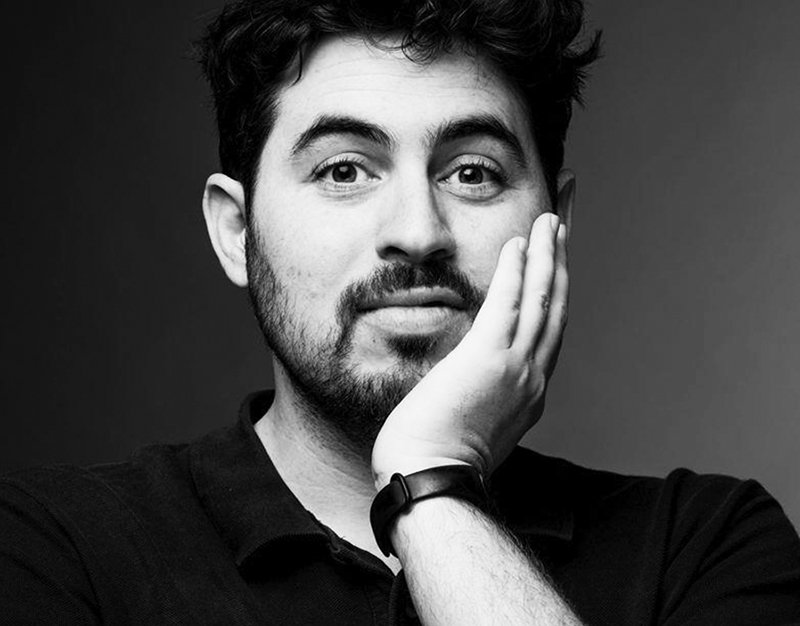
It’s not always so bad; this is one of his “terrible days” – though you wouldn’t know it from the man I see on my screen, a gushy high-energy type with a trim beard and great thatch of hair. Still, the disease hasn’t gone away. “It’s a chronic illness,” he confirms in fluent but non-native English. “People look at me like a – a medical miracle, that I kind of healed. I’m afraid it cannot be really cured, but you can manage it if you do a lot of self-care, rehabilitation, mindfulness, [and] of course regular medication and regular treatment.”
His routine includes yoga and meditation, along with careful nutrition and the use of a special fitness/rehabilitation programme – but there’s no easy answer to the question of how to beat Pots. “I’m on a constant journey to always find what’s best for me,” says Roi. Everyone must discover what works for them, “for some people it’s yoga, for some it’s shiatsu or dancing”. My attempts to pin him down are complicated by the fact that Zoom, too, seems to be running a fever on this occasion, prone to glitches and relaying my questions with a few seconds’ time-delay (in the end I keep the questions to a minimum, so we don’t talk over each other) – yet it’s also true that the details of his regimen are not, in the end, the point. That’s the moral of the story Roi tells about “the darkest night of my life”, a story he’s often recalled in TED talks and other speeches.
We’ll get to the story later; but first it’s worth noting what Pots is – and what it isn’t. ‘Tachycardia’ means the heart is beating faster than it should – yet this isn’t a heart condition, it’s a nervous-system ailment. As he says, “the nervous system is not synchronising the autonomic functions of the body very well. Digestion, blood pressure, breathing, sweat – everything that is parasympathetic in the autonomic nervous system is completely dysregulated… I’ve had more than 30 symptoms throughout the years.” If the body were a computer it’d be the central processor itself that was malfunctioning, overheating or shutting down at the slightest provocation.
 There’s another, even scarier fact to note about Pots: it’s not rare – or, at least, not as rare as it was. “It used to be considered a rare disease,” explains Roi, “but lately it’s stepped out of the list of rare diseases. Now, instead of one in a million, they’re talking about 50 in 100,000, so it’s not rare. In America there are a lot of cases.” One might say it’s joined a host of other disorders (Crohn’s disease, Lyme’s disease, IBS, chronic fatigue, fibromyalgia) that were totally obscure till quite recently, but are now increasingly common. Indeed, if there’s one key takeaway – one line to heed, and commit to memory – from my conversation with Roi Shternin, it might be what he says when I point out this trend. “Covid is a joke,” he replies, chillingly, “compared to what we’re facing. We’re talking about the chronic-illness epidemic that is coming, and is already here.”
Two other points flow from this. The first is that these are probably disorders linked in some way to modern living; “My suspicion is [that] it has environmental causes,” he agrees, albeit vaguely. The second has to do with that ‘probably’ in the first sentence: no-one’s really sure how to deal with these illnesses, and doctors – especially doctors 15 years ago, when Roi collapsed while working his usual shift as a paramedic – are likely to dismiss them as psychosomatic. “It’s all in your head,” he recalls being told more than once, even as he lay in bed unable even to shift position without fainting. Then there were the doctors who took the diametrically opposite – but equally unhelpful – view: not that his (still-undiagnosed) illness didn’t exist, but that it did exist and indeed was so serious as to be incurable. “You should buy him a mattress,” he recalls in his TED talk, quoting what a prominent physician told his parents (Roi was 25 at that point; he’d been bedridden for about three years). “A very comfortable one – so he can grow old with dignity.”
That led to the aforementioned story, the “darkest night of my life” when he returned from this eminent professor “who’d told my parents I will never walk again, never work, never go to university, never marry a woman, basically sentenced me to death – and I came back home, and I had a decision to make: whether I’m healing myself, or killing myself”. The second option seemed initially the more attractive; he thought about suicide – but realised, much to his disgust, that he didn’t even have the strength to do that. “I just lay there, miserable, and thought: ‘This is so stupid! I’m so sick I cannot even kill myself!’… This was a total loss of hope,” recalls Roi with the air of a tennis player tossing up the ball before smashing an ace. “And then what I call this miraculous moment happened.”
A ray of light from the street lamp outside fell on a book on his nightstand, which his brother had bought a week before. The book was called Man’s Search for Meaning, written in 1946 by Dr Viktor Frankl, an Austrian neurologist and Holocaust survivor. Dr Frankl wrote some of it while still in Auschwitz, “trying to understand why some of the people around him are surviving the death camp… They have something that made them survive, in terms of their mentality,” says Roi shrewdly, putting a finger to his temple, “[while] some people who arrived there maybe healthier are dying, because they didn’t have any reason to live for.” Roi had already tried and failed to watch TV – just reaching for the remote made him faint – but the book was close enough to grab. He read the whole thing in one night, “and when I closed it, I said: ‘There is nobody in the world that can help me. I’m taking responsibility for my own situation. And I’m going to find a diagnosis, I’m going to walk again, I’m going to get married…’ And this was the start of my mental and physical process.”
That, in a nutshell, is his story, his keynote speech – the irony being that the doctors, inadvertently, had been right all along: ‘It’s all in your head’, in the sense that state of mind is vital in trying to manage his illness (or any illness). Then again, one might also argue that Dr. Frankl was only half-right. Having “something to live for” implies some external factor – having a dream, or a family – but perhaps one also needs a survivor’s personality, the kind that’ll latch on to that reason to live and translate it into actual, stubborn living.
One of his grandmothers, for instance, as a child of 11 or 12 during the war, spent three years in the woods hiding out from the Nazis. “We don’t know exactly what she did there,” says Roi (she was probably adopted by some partisan group). “But she survived.” Israel itself – he’s from Hadera, a seaside town known for its famously tall power plant – is a case study in stubborn survival. “When you come from Israel, you see that nothing comes easily. It’s not like somebody gave us a billion dollars and said ‘Build a country’. Everything is” – he hesitates – “tense all the time.” That tension was probably why he got sick in the first place, having come under terrible stress as a soldier and Red Cross paramedic during the second intifada – bolstering the case for Pots as lifestyle-related, though in fact it can also emerge in response to a virus (many recovered Covid patients are now reporting Pots-like symptoms). But there’s also Roi’s own personality, helping to explain both why he worked as a paramedic and why he’s ended up managing the disease like he has.
“I’m a – how do they call it, a ‘Campaigner’,” he says with a chuckle, citing the well-known ‘16 personality types’. “I was always a little rebel, but not against my parents or my teachers. I hated injustice. I even got kicked out of high school because there was a huge injustice happening to one of the students, and I kind of shut down the school and wrote letters to the Ministry”. Working as a paramedic – saving lives, dreaming of becoming a doctor – came naturally to him. Campaigning for healthcare and patients’ rights, and trying to prevent others from suffering what he had to suffer, now comes just as naturally.
Sharing his story spreads awareness, of course; but it’s more than that. “I will go anywhere in the world to speak, if somebody wants to listen to what I have to say,” he affirms with feeling. He’s “very honoured” to speak at Reflect, very honoured to be doing this interview, he says more than once – partly, I suspect, for his own benefit, because this is part of what keeps him going; it’s his ‘something to live for’. His schedule would wear out a man who was totally healthy, let alone one for whom “pressing the ‘Lock’ button on my phone is too hard sometimes”. He recalls being in nine countries in seven days – this was pre-corona – “and in the last flight I could barely walk to the aeroplane”.
It’s not just speeches and engagements, though; it’s also projects and start-ups and NGOs. Roi teems with ideas, plus the entrepreneurial flair to bring them to fruition. He’s developed an app called Help+, allowing patients to call a hospital at the touch of a button (probably recalling how he himself was too weak even to turn on the TV, let alone make a phone call). He’s launched ‘Project Hearts’, teaching underprivileged kids to become first-aid instructors. Other projects include Valero Clinical and Labriut – and he’s also founded the patient-led Dysautonomia Israel society, served on boards, taught in colleges, written poetry. He’s currently writing a book called Revolution From Our Beds, writing the script for a documentary to be called – yes! – It’s All in Your Head, working with doctors in Vienna as a Patient in Residence. The list goes on.
“But you know, I think people like me always have this feeling that we’re not doing enough,” he says, confirming the sense that furious activity is a massive part of his self-care. “I always wake up in the morning and say ‘I’m not doing enough, I need to do more projects and more things!’… And I want to do more for Cyprus too, it’s such lovely people, such a lovely country.” (Turns out his parents own a holiday home in Ayia Napa.) The one missing piece is perhaps that he isn’t married yet – that being one of the promises he made to himself on that fateful night – but he’s “in a wonderful relationship” so the point is probably moot.
Roi Shternin’s story might be fascinating at any time, but it’s especially relatable now. The pandemic, in a sense, has done to all of us what Pots did to him, brought us face-to-face with our fragile bodies, made uncertainty about health a part of our daily life, shaken our faith in the power of medical science to meet every challenge and answer every question (Roi, too, became disillusioned with doctors, whom he once idolised as “angels in white”). His story may also be a hint of things to come, the epidemic of debilitating, modern-life-related illnesses he claims is just around the corner – yet the message is the same in any case: the search for meaning, the importance of something to live for, above all the need to take charge and work to get better. “I actually managed my own start-up,” he quips, lapsing into TED-speak again, “which was my body”. Be your own CEO, you’ll live longer.



/pic9772199.png)